


In the thematic context of the next issue of ArteIn—dedicated to The Guardians of Memory—would it be possible to define your work, which will be performed as a theatrical summa in Grazzano Visconti, as a kind of “intimate diary of contemporaneity”?
The word summa fits my work very well. I consider myself a medieval artist, deeply inspired by the Flemish Primitives, the Flemish Masters such as the Van Eyck brothers, Breughel, Bosch, and others. I am a dwarf born in a land of giants. It is with this humble awareness that my work in visual arts, theater, and writing is steeped in memory. There is no avant-garde without tradition. I write and draw in the obscurity and obscenity of the night, still with a pen, still by hand. The drawings become writings, and the writings become drawings in the taboo-free zone of the night, where I am free from contemporary life. I have nothing to do with the contemporary art world.
To what extent has your family experience—a recurring theme in both your artistic and theatrical production—shaped your vision and understanding of contemporary social and collective life?
I am the child of a typical Belgian marriage. My father, Edmond Fabre, came from a poor communist family, and my mother, Helena Troubleyn, from a wealthy Catholic family. The anarchy of love brought them together. They had the greatest influence on my artistic formation and career. My father, who was an excellent classical draftsman, gave me a passion for painting and drawing. He was an expert in botanical gardens, and as a child, he took me to the Antwerp Zoo to draw animals and people, introducing me to the physiognomic studies of Lavater. Later, he brought me to the Rubens House to copy the paintings and drawings of Rubens. He taught me that imitation is a great form of intelligence. My mother instilled in me a love of literature and language. She translated all the great French poets and chansonniers for me when I was a little boy. Thus, all my visual and theatrical work is a combination of the friction between image and language.
I also inherited from my family some original books by the French entomologist Jean-Henri Fabre. His studies of insects have profoundly inspired both my visual and theatrical art.
I am not contaminated by the disease called “internationalitis.” I am a very provincial artist and, for that reason, universal.
If “memory has a future,” to quote one of our authors, Leonardo Sciascia, what do you imagine the future of art will be—the art that will be remembered?
I believe in humanity and in the future. If you compare angels with humans, angels are guiltless, perfect, unique, and static. Humans are always guilty, imperfect, unoriginal, and constantly in motion. Yet, despite this, we don’t do too badly with only 1300 grams of grey matter in our skulls. We are so creative that we always find solutions. As Marcel Duchamp said, if there are no problems, there are no solutions. It’s all about passion. A true artist will always continue because, on paper, they can turn a square into a flying carpet.
How would you describe your relationship—perhaps the bond—with the Italian artists who bring your work to life on stage in Italy, particularly in Grazzano Visconti?
What unites us is that we kneel before beauty. We are Servants of Beauty. I spent a few hours listening to Carolina Migli approach my Diario Notturno. The more I watched her work, the stronger and more passionate she became—her femininity began to shine, and she blossomed with energy. Edoardo Cagliari, whom I first discovered as a highly sensitive and detailed poet with an authentic voice, took care of the dramaturgy and the selection of fragments from my five diaries, published in Naples by Cronopio. He handled it in a very serious, authentic, and intelligent way.
Which artists and authors of this century, in addition to yourself of course, do you think deserve to be remembered and appreciated more?
For my theater art, I have always deeply admired the Polish master Tadeusz Kantor for his intense and innovative stage works—particularly his masterpiece The Dead Class—and for his visionary writings. To me, he was the last great European theater artist.
In visual arts, I would mention the Russian artist Ilya Kabakov.
As for writers and philosophers, the ones who have influenced me the most are Michel Foucault, especially his book Discipline and Punish, which inspired me regarding the organization of bodies in space and the disciplined body, and Henri Bergson.
Jan Fabre, September 18, 2024

Jan Fabre, il “Giornale notturno” a Grazzano Visconti, a cura di Edoardo Callegari e Carolina Migli Bateson
A Grazzano Visconti, metaluogo della geografia italiana, sito favoloso che elude il tempo e, ci manca poco, pure lo spazio – a stento la segnaletica stradale lo indica (meno male che c’è google maps, a cui nulla si nasconde, nemmeno il regno di Hogwarts) -, è andato in scena, mentre stampiamo e diffondiamo questo numero di ArteiN, uno spettacolo inedito sulle scritture di Jan Fabre: il Giornale notturno”.
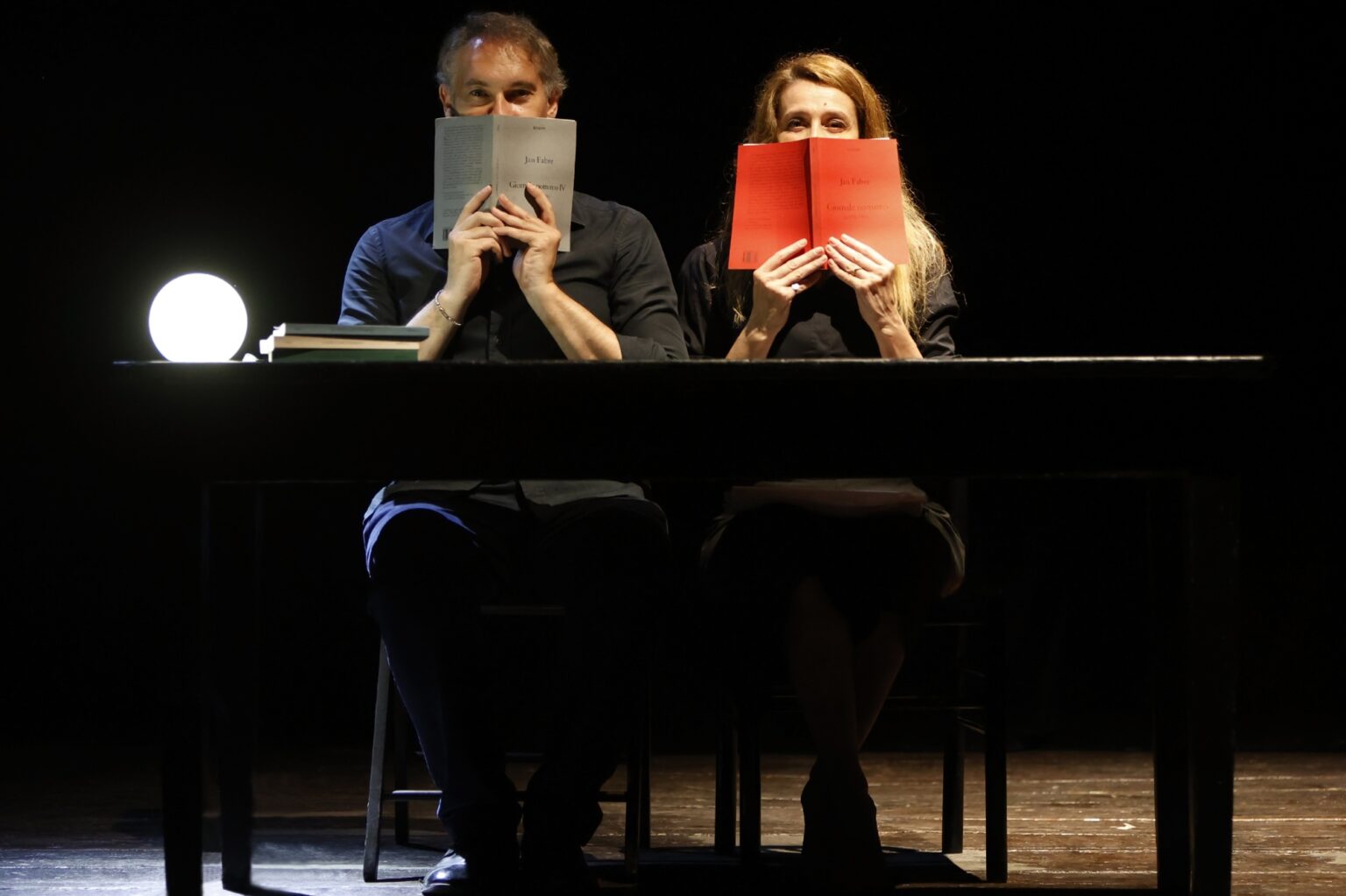
Arrangiato drammaturgicamente da Edoardo Callegari: prima poeta, poi anche attore e scrittore di teatro di gran vaglia, interpretato scenicamente da Carolina Migli Bateson, prima attrice (nel senso proprio delle gerarchie teatrali) e poi anche fervente, animosa e coraggiosa promotrice di progetti scenici che, con benemerita caparbietà, mantengono alta e vibratile la tradizione più nobile e sincera dell’arte che ancora scarroccia sul carro di Tespi.
Il teatro, nella accezione primaria, è stato il punto di incontro – che solo nei territori misteriosi della magia sarebbe potuto avvenire, ovvero a Grazzano Visconti – tra il celebre performer artista olandese e l’associazione teatrale ChezActors, creatura ribollente come i pentoloni delle streghe della Bateson (lei è una fata, ma nella tradizione la differenza è flebile, indistinguibile), che negli ultimi anni ha convinto, nientemeno, la famiglia Visconti, duchi di Milano e pertinenze storiche, con residenza campagnola nel piacentino (è qui che si trova Hogwarts, per tutti i ghostbusters), a riattivare il teatrino del borgo, voluto da Luchino Visconti, figlio del duca Giuseppe Visconti di Modrone e di Carla Erba, con la quale l’erede novecentesco della stirpe del Biscione si era sagacemente coniugato.
Una combinazione metastorica, metatopica, metafisica insomma, dalla irresistibile potenza. Tant’è vero che convincere Jan Fabre (che ha esposto con una personale negli stessi giorni delle rappresentazioni alla galleria Gaburro di Milano) a mettere in scena il suo “Giornale notturno”, per lo ieratico galantuomo che risponde al nome autorale di Edoardo Callegari, non è stato per nulla complicato. Ma anzi: naturale, consequenziale, logico nella imprendibile, imperscrutabile logicità della magia delle cose terrene.
Lo spettacolo è risultato intensissimo, come i testi di Fabre impongono, soprattutto nelle versioni dei suoi diari insonni, e tuttavia soffuso e permeato della gentilezza delicata, mai retorica, infusa dal drammaturgo piacentino, che ha instillato nella fumantina, veracissima Bateson un ritmo “in minore”, una tonalità “diminuita”, direbbero i critici musicali, che ha colorato la pièce di solennità e ritmo assai ben adattabile all’udito e alla percezione di un pubblico non avvezzo alla crudezza della verità della vita, ma non perciò meno sensibile ad essa. Una sintesi felice, o per meglio dire magica, di franchezza norrena e di eleganza mediterranea.
Immagine di copertina: Edoardo Callegari e Carolina Migli Bateson – Courtesy Ufficio Stampa Teatro Out Off
Scopri qui i contenuti esclusivi di ArteiN!